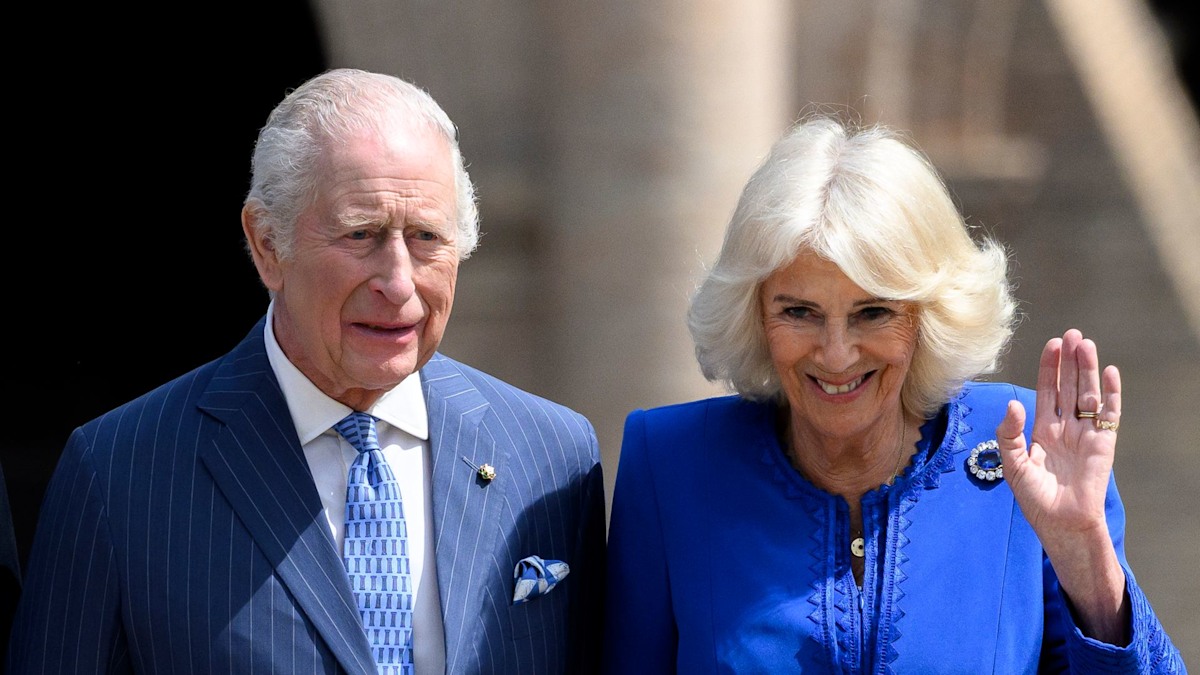
King Charles III is set to address a joint session of the United States Congress today—an extraordinary event that underscores the deep, complex ties between the United Kingdom and America. This is not merely ceremonial. It’s a diplomatic act loaded with symbolism, timing, and subtext. As lawmakers gather on Capitol Hill and global media turn their lenses toward Washington, the significance of a reigning British monarch speaking before the U.S. legislative body cannot be overstated.
Live updates are pouring in from the Capitol, confirming arrival times, seating arrangements, and behind-the-scenes coordination. The King, accompanied by Queen Camilla, arrived at the U.S. Capitol just after 10:15 a.m. Eastern Time. Security was tightened, with barriers lined along Pennsylvania Avenue and drone detection systems active overhead—standard protocol, but amplified for a head of state on historic ground.
This address marks only the fourth time a British monarch has spoken to a joint session. Queen Elizabeth II did so in 1957 and 1976. King George VI addressed Congress in 1939. The rarity alone makes this a pivotal moment in transatlantic history.
Why This Address Matters Now
The world is not in a stable state. Geopolitical tensions, climate instability, and democratic backslips across several nations have redefined the roles of traditional allies. The U.S. and U.K. are navigating post-Brexit realities, evolving trade dynamics, and shared security concerns—from Ukraine to the Indo-Pacific.
By addressing Congress, King Charles is stepping beyond protocol. While the British monarch is constitutionally apolitical, the platform of Capitol Hill allows him to amplify values—environmental stewardship, youth opportunity, interfaith dialogue—that have defined his decades-long advocacy. This isn’t a power play. It’s a values-based appeal, delivered through historical continuity.
Observers note that the King’s speech will avoid direct commentary on U.S. domestic affairs, a necessary boundary. But references to “shared democratic resilience” and “common burdens” are expected. These are carefully calibrated phrases, signaling unity without overreach.
The King’s Arrival: Ceremony Meets Substance
Charles and Camilla were greeted at the West Front of the Capitol by House Speaker Mike Johnson and Senate Majority Leader Chuck Schumer. A ceremonial welcome included a military honor guard, the playing of both national anthems, and a receiving line of congressional leaders.
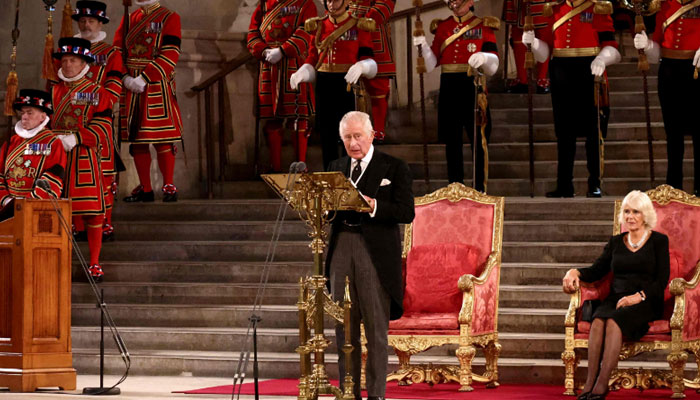
Camilla remained seated in the gallery during the address—a tradition dating back to Queen Elizabeth’s visits. The royal couple sat separately from President Biden and Vice President Harris, who occupied the front row on the House side—a visual reminder of the separation between head of state and head of government.
Notably, several Republican lawmakers skipped the session. While some cited scheduling conflicts, others made pointed statements in the days leading up to the event—questioning the relevance of monarchy in a modern democracy. These absences serve as a quiet counter-narrative to the moment’s grandeur.
Still, the chamber was largely full. Democrats and key Republicans alike attended. The atmosphere was respectful, even reverent at moments—especially during the King’s tribute to American veterans and his nod to the D-Day 80th anniversary commemorations earlier this year.
What the Speech Covered: Key Themes and Quotes
The King’s 25-minute address struck a tone of humility, partnership, and quiet urgency. He opened by referencing his mother’s previous speeches to Congress, calling her 1957 address “a beacon of hope during the Cold War.”
“In an age of algorithms and artificial intelligence, it is human connection that remains our most vital technology,” he said—an elegant framing of his long-held belief in community-led solutions.
Three core themes emerged:
- Climate and Nature Restoration
- Charles called on both nations to “reimagine our relationship with the natural world.” He spotlighted the Sustainable Markets Initiative, a project he launched in 2020, urging U.S. businesses and lawmakers to adopt regenerative agriculture and circular economic models. He did not demand policy changes but encouraged “pragmatic, scalable action.”
- Youth and Education
- Citing the mental health crisis among young people, he advocated for education systems that prioritize emotional resilience and practical skills. “We must equip not only minds, but hearts,” he said. This line drew quiet applause, particularly from lawmakers focused on youth outreach.
- Democracy and Civic Responsibility
- Without naming specific countries, he warned against “the corrosion of trust” in public institutions. He praised American civic engagement—calling it “the lifeblood of democracy”—and urged young people on both sides of the Atlantic to step into public service.
Notably, he referenced Martin Luther King Jr.’s 1963 visit to the U.K., drawing a link between civil rights and global justice. It was a subtle but powerful inclusion—acknowledging the U.S.’s internal struggles while affirming shared moral aspirations.
Behind the Diplomacy: What’s Not Being Said
While the speech avoided controversy, the diplomatic choreography was intense. The invitation to speak came months ago, but timing was deliberate. With a U.S. election looming and the U.K. facing economic headwinds, both governments wanted a moment of unity.
The White House pushed for Charles to speak—partly to strengthen ties with a reliable ally, partly to contrast democratic stability with global autocracies. For the King, the platform allows him to champion causes that might be harder to advance through royal tours alone.
But risks exist. The monarchy remains a polarizing institution, even in Britain. Some American lawmakers saw the event as outdated—a living symbol of colonial hierarchy addressing a republic born from rebellion. One representative from Oregon released a statement saying, “We honor history, but we must not confuse ceremony with progress.”
Still, the optics were powerful. Images of the King at the podium, flanked by the American and Union flags, will circulate globally—reinforcing the idea of a steady, values-driven alliance.
Public Reaction and Media Coverage
As the address concluded, live reactions flooded social media. #KingCharlesCongress trended on X (formerly Twitter), with over 380,000 mentions in the first hour. Reactions were mixed but leaned positive.
British outlets praised the King’s “dignified gravitas.” The BBC called it “a masterclass in soft power.” The Guardian highlighted his emphasis on climate justice, noting, “He spoke not as a monarch, but as a man who has spent 50 years trying to be heard.”
In the U.S., coverage was more measured. Fox News downplayed the speech’s significance, framing it as “symbolic theater.” CNN and MSNBC offered deeper analysis, focusing on the diplomatic context and Charles’s advocacy legacy.
On the ground, public engagement was limited. Only credentialed media and invited guests attended. But schools across both nations streamed the speech in civics classrooms—a sign that educators see value in the moment, regardless of political views.
How This Compares to Past Royal Addresses
Only three British monarchs have addressed Congress. This makes direct comparison possible—and revealing.
| Monarch | Year | Key Focus | Political Climate |
|---|---|---|---|
| King George VI | 1939 | Wartime alliance, peace efforts | Pre-WWII, rising global conflict |
| Queen Elizabeth II | 1957 | Cold War solidarity, democracy | Height of U.S.-U.K. intelligence cooperation |
| Queen Elizabeth II | 1976 | Bicentennial unity, shared values | Post-Vietnam, Watergate era |
| King Charles III | 2024 | Climate, youth, democracy | Polarization, AI disruption, climate crisis |
What stands out? Each address responded to a crisis of confidence. In 1939, it was war. In 1976, it was legitimacy. In 2024, it’s sustainability—of both ecosystems and democratic norms.
Charles’s speech was less ideological than his mother’s 1957 address but more urgent than her 1976 remarks. He avoided direct policy asks but framed challenges in human terms. That’s his signature: not legislation, but moral persuasion.
What Comes Next?
The King departs Washington this evening for a brief stay in New York, where he’ll attend a climate-focused reception hosted by the United Nations. That event—closed to the public—will likely generate fewer headlines but may yield more tangible outcomes. Diplomacy often works best off-camera.
Back in Congress, no immediate legislation is expected from the address. But seeds were planted. Lawmakers involved in environmental and youth initiatives say they’ll reference the speech in upcoming debates. One bipartisan group is already drafting a resolution honoring the U.K.-U.S. climate partnership—a direct nod to Charles’s advocacy.
For the monarchy, the long game continues. This address wasn’t just about today. It was about shaping perception—of the Crown as relevant, compassionate, and forward-looking. In an era of republicanism and skepticism, Charles is betting that moral authority can outlast tradition.
The Takeaway: Symbolism
with Substance
King Charles’s address to Congress was more than pageantry. It was a strategic, emotionally intelligent appeal for unity in turbulent times. He didn’t lecture. He connected.
He spoke as a monarch, yes—but also as a man who has spent decades warning about climate collapse, supporting marginalized youth, and defending civic institutions. Today, he stood on one of democracy’s highest stages and reminded two nations of their shared responsibility.
Will it change policy? Maybe not immediately. But it reminded people—lawmakers, citizens, students—that leadership isn’t just about power. It’s about voice.
And today, the King’s voice was heard.
FAQ
Did King Charles have input on the speech content? Yes. While royal speeches are typically drafted with input from advisers and government officials, Charles is known to closely shape his own messaging, especially on environmental and social issues.
Can a British monarch influence U.S. policy? Not directly. The monarchy holds no political power in the U.S. However, symbolic influence—especially on shared values—can indirectly shape public discourse and bipartisan priorities.
Why was Queen Camilla not seated with congressional spouses? Tradition. During joint sessions, the spouse of a foreign head of state typically sits in the gallery, separate from U.S. officials, to maintain ceremonial balance.
How long was the King’s speech? Approximately 25 minutes—a standard length for joint session addresses, balancing impact with attention span.
Were there protests outside the Capitol? A small group of anti-monarchy demonstrators gathered near the Ellipse, but no major disruptions occurred. Security managed the perimeter without incident.
Has any other royal family member addressed Congress? No. Only reigning British monarchs have been invited to speak before a joint session.
Was the President required to attend? Not legally, but it’s a strong diplomatic norm. President Biden’s presence underscored the importance the U.S. places on the U.K. alliance.
FAQ
What should you look for in King Charles to Address Congress in Historic Joint Session? Focus on relevance, practical value, and how well the solution matches real user intent.
Is King Charles to Address Congress in Historic Joint Session suitable for beginners? That depends on the workflow, but a clear step-by-step approach usually makes it easier to start.
How do you compare options around King Charles to Address Congress in Historic Joint Session? Compare features, trust signals, limitations, pricing, and ease of implementation.
What mistakes should you avoid? Avoid generic choices, weak validation, and decisions based only on marketing claims.
What is the next best step? Shortlist the most relevant options, validate them quickly, and refine from real-world results.